
About Bambarakanda Falls
Tucked away in the cool highlands of the Badulla District, near the little village of Kalupahana, Bambarakanda Falls is the crown jewel of all our waterfalls. Standing at a staggering 263 metres, it is the tallest waterfall in Sri Lanka, and one of the tallest in all of Asia. When the water is in full flow, the cascade tumbles down a sheer rock face in three distinct ribbons of silver, framed by a fragrant forest of pine trees that you would be forgiven for mistaking for some far-off temperate hillside rather than a tropical island.
Fed by the Kuda Oya, a tributary of the great Walawe River, Bambarakanda sits quietly off the beaten track, far from the tourist crush. That is precisely its charm. While crowds gather at the more famous falls, here you can stand at the base, crane your neck towards the top, and feel very small in the best possible way. If chasing waterfalls is your idea of a perfect island day, this one belongs at the very top of your list.
How to Get There
Bambarakanda Falls is roughly 5 km off the main A4 Highway, reached via a turnoff at Kalupahana. Kalupahana lies between Beragala and Belihuloya, so the falls are very easy to fold into a hill country road trip.
If you are coming from Haputale, you are in luck, as it is one of the closest larger towns, sitting about 30 to 35 km away. The drive winds down through tea estates and misty mountain bends before you reach the Kalupahana turnoff. From Ohiya, the tiny railway halt famous as the gateway to Horton Plains, you can also reach Kalupahana on the descent, which makes a beautiful combined day if you plan it well.
Once you reach Kalupahana on the A4, you take the side road towards the village of Bambarakanda. The road climbs for about 4 to 5 km through the pine forest until you reach the area near the base of the falls. The road is narrow and rough in patches, so a Tuk Tuk or a sturdy vehicle is your best bet for this final stretch.
Read all about getting Tuk Tuks for a ride in Sri Lanka on our Tuk Tuk Guide!
If you are travelling by public transport, take a bus along the A4 towards Kalupahana and get off at the Bambarakanda junction. From there you will need to arrange a Tuk Tuk or be prepared for a long uphill walk to reach the falls.
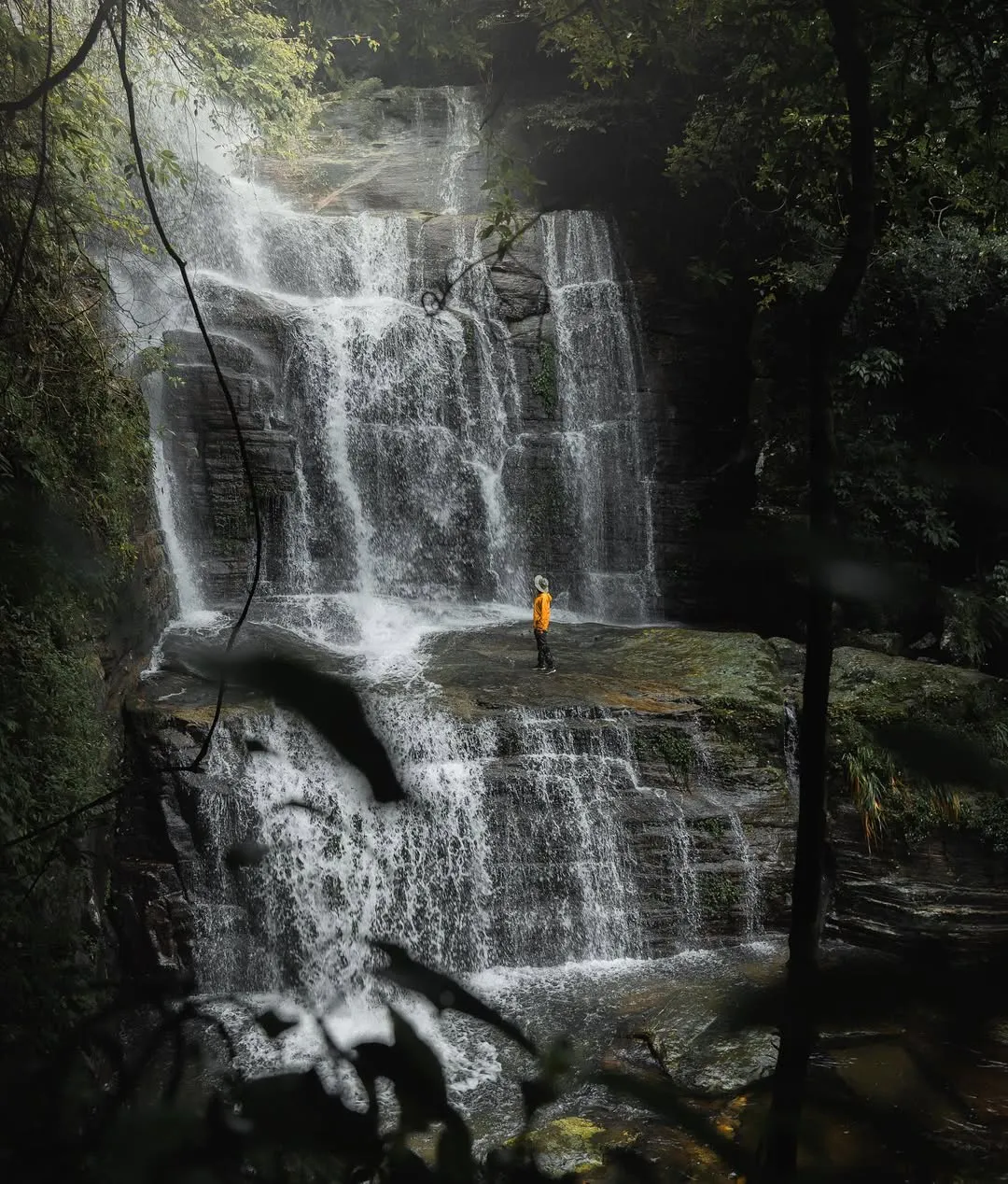 The tallest waterfall in Sri Lanka, framed by pine forest near Kalupahana.
The Hike to the Base
The walk to the base of Bambarakanda is the most popular and the most accessible. From the parking and village area, it is a gentle 15 to 20 minute walk along a forest path towards the foot of the falls. The trail meanders through the pine woods, where the air is crisp and the ground is carpeted with soft fallen needles, and the only soundtrack is birdsong and the growing rush of falling water.
As you approach, the falls reveal themselves bit by bit through the trees until you are standing right at the base, looking up at that immense column of water. On a good day the spray drifts across your face like a fine mist, cooling you instantly. There is a small pool at the bottom where many visitors like to cool their feet, but more on safety in a moment.
The Hike to the Top
For the more adventurous, there is a separate trail that climbs up to the top of the falls. This is a tougher trek, taking anywhere from one to two hours depending on your pace and the conditions, and it winds steeply through the pine forest. The reward is a sweeping view out over the valley and, on a clear day, layers of distant mountains fading into the haze.
We will be honest with you here, as the path to the top is far less defined and can be slippery, especially after rain. The area near the very top of any waterfall is dangerous, and there are no barriers. If you intend to hike to the top, it is well worth hiring a local guide from the village, both so you do not lose the trail and so you have someone who knows the terrain in case of trouble.
Best Season to Visit
Like all our waterfalls, Bambarakanda is at its mightiest in the wet months. When the rains have been generous, the full three-pronged cascade thunders down the rock face in all its glory, and the spray fills the whole valley. This is the most spectacular time to see it.
During the dry season, roughly from February to April, the flow thins out considerably. The waterfall is still beautiful, and the trails are easier and safer to walk, but you will see a far gentler trickle rather than a roaring torrent. So there is a trade-off to weigh, with the wettest months bringing the most dramatic falls but the muddiest, most slippery paths.
To plan your trip around the island's rather complicated weather patterns, have a look at our guide on the best time to visit Sri Lanka. The hill country has its own rhythm, and a little planning goes a long way.
The Pine Forest
One of the most surprising things about Bambarakanda is the setting itself. The falls are cradled within a planted pine forest, a landscape that feels worlds away from the coconut palms and paddy fields most people picture when they think of Sri Lanka. Walking beneath the tall, straight pines, with the scent of resin in the cool mountain air, is a genuinely otherworldly experience.
The forest makes the whole area a lovely spot to slow down. Many visitors bring a picnic and spend a few unhurried hours here, listening to the falls and breathing in the highland air. Just remember that this is a fragile, beautiful place, so whatever you bring in, you carry back out with you.
Safety First
Bambarakanda is breathtaking, but it deserves your respect. A few things to keep in mind:
-
The rocks around the falls are extremely slippery, particularly when wet. Wear shoes with good grip and watch every step.
-
Be very cautious about swimming or wading. The pool at the base can be deceptively powerful, and water levels can rise quickly and without warning after rain upstream. Sadly, this waterfall has seen accidents, so do not take risks for a photo.
-
Never climb on the rocks right at the edge of the falls, top or bottom.
-
The hike to the top should not be attempted alone or in poor weather. Hire a local guide.
-
Mobile signal can be patchy, so let someone know your plans before you set off.
What to Bring
-
Sturdy shoes or hiking sandals with good grip.
-
Plenty of drinking water and some snacks, as there are limited facilities at the falls.
-
A light rain jacket, since hill country weather changes in a heartbeat.
-
A warm layer, especially if you are visiting early in the morning when the highlands are genuinely chilly.
-
A dry bag or zip-lock to protect your phone and camera from the spray.
-
Insect repellent for the forest trail.
-
A bag to carry your rubbish back out with you.
Combining with Horton Plains
Here is where Bambarakanda's location truly shines. The falls sit right on the route up towards Horton Plains National Park, one of the most magical highland landscapes on the island and home to the famous World's End precipice. Many travellers visit Bambarakanda either on the way to or from Horton Plains, turning a single excursion into an unforgettable day in the highlands.
If you base yourself in Haputale, Ohiya or nearby Belihuloya, you can chain together the waterfall, the pine forest and the misty plains with relative ease. To plan the wider adventure, see our guide to Horton Plains and Sri Lanka's national parks, and pack for cold, early starts, as the plains are best explored at dawn before the clouds roll in.
Other Places to Visit Nearby
- Horton Plains National Park and World's End
- Lanka Ella Falls
- Diyaluma Falls
- Belihuloya
- Haputale and Lipton's Seat
Bambarakanda is a reminder that Sri Lanka keeps surprising you, that an island of beaches and tea can also offer a 263-metre cathedral of falling water hidden in a pine forest. Go see it for yourself.
Safe travels! And remember, "Take Only Pictures, Leave Only Footprints".